Law enforcement and security personnel who are victims of sociopolitical violence compensated
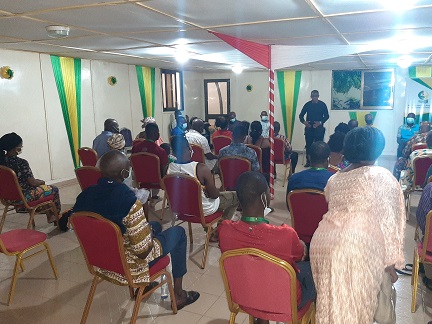
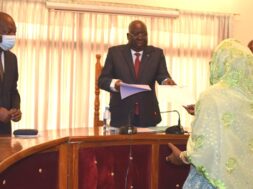
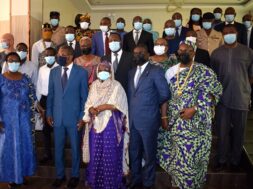
The High Commission for Reconciliation and Strengthening of National Unity (HCRRUN) held, from Tuesday, July 13 to Thursday, July 15, 2021, a compensation session at its headquarters in Lomé, specifically for members of the national police who were victims of socio-political violence. During this session, nearly 90 serving or retired police officers, or their beneficiaries, received compensation. These victims were identified either from the CVJR database or from the report of the Independent Special Commission of Inquiry, commonly known as the “Koffigoh Commission.” This commission was established to shed light on the violence that followed the unrest after the death of the late President Gnassingbé Eyadéma and the 2005 presidential election.
This symbolic reparation forms part of the transitional justice process adopted by Togo. Through the HCRRUN, the State seeks to provide comfort and relief to police officers who suffered harm as a result of violence between 1958 and 2005. In other words, the State cannot show selective compassion towards victims.
Indeed, for decades, public demonstrations have sometimes been marked by security incidents, during which law enforcement officers have been attacked by groups of demonstrators. Police stations have, on occasion, been attacked and set on fire. During such episodes of violence, police officers were injured, while others lost their lives or their property.
Former Prime Minister and Special Advisor to the HCRRUN, Me Joseph Kokou Koffigoh, explained that police officers, in carrying out their duties, are sometimes confronted with such incidents. In these situations, he noted, when victims are being identified, these officers are often “forgotten.” Given that the process seeks to strengthen national unity, Me Koffigoh considered this session above all as an expression of compassion and recognition for the difficult mission carried out by the victims. According to him, the reparation programme is based on documented evidence and seeks to ensure that transitional justice takes root effectively and inclusively.
The beneficiaries of the compensation welcomed the HCRRUN’s initiative and paid tribute to the Head of State for his policy of reconciliation.
“On behalf of all retired police officers who were victims, as well as those still serving, I would like to thank the President of the Republic for his security and reconciliation policy. As victims of socio-political violence in the course of maintaining public order, we express our gratitude to him. People often believe that the security forces are always responsible for negative acts. We are deeply moved that the HCRRUN is organizing this compensation session for us today, because some among us were assaulted, others were killed, and some saw their property ransacked. It is not the financial reparation itself that matters most, but rather the recognition of what we do for this country. We are happy. We are part of a transitional justice process. At certain times, it must also be acknowledged that excesses may occur during our security operations, and we wish to offer our sincere apologies to the Togolese people and ask forgiveness from all citizens who have been victims of our public-order operations,” emphasized one of the victims, a retired police officer.
Furthermore, the HCRRUN will organize additional compensation sessions for the remaining victims within the national police who have not yet received compensation. Sessions will also be scheduled for victims among the personnel of the Ministry of the Armed Forces, including military personnel and gendarmes, as well as members of other corps.