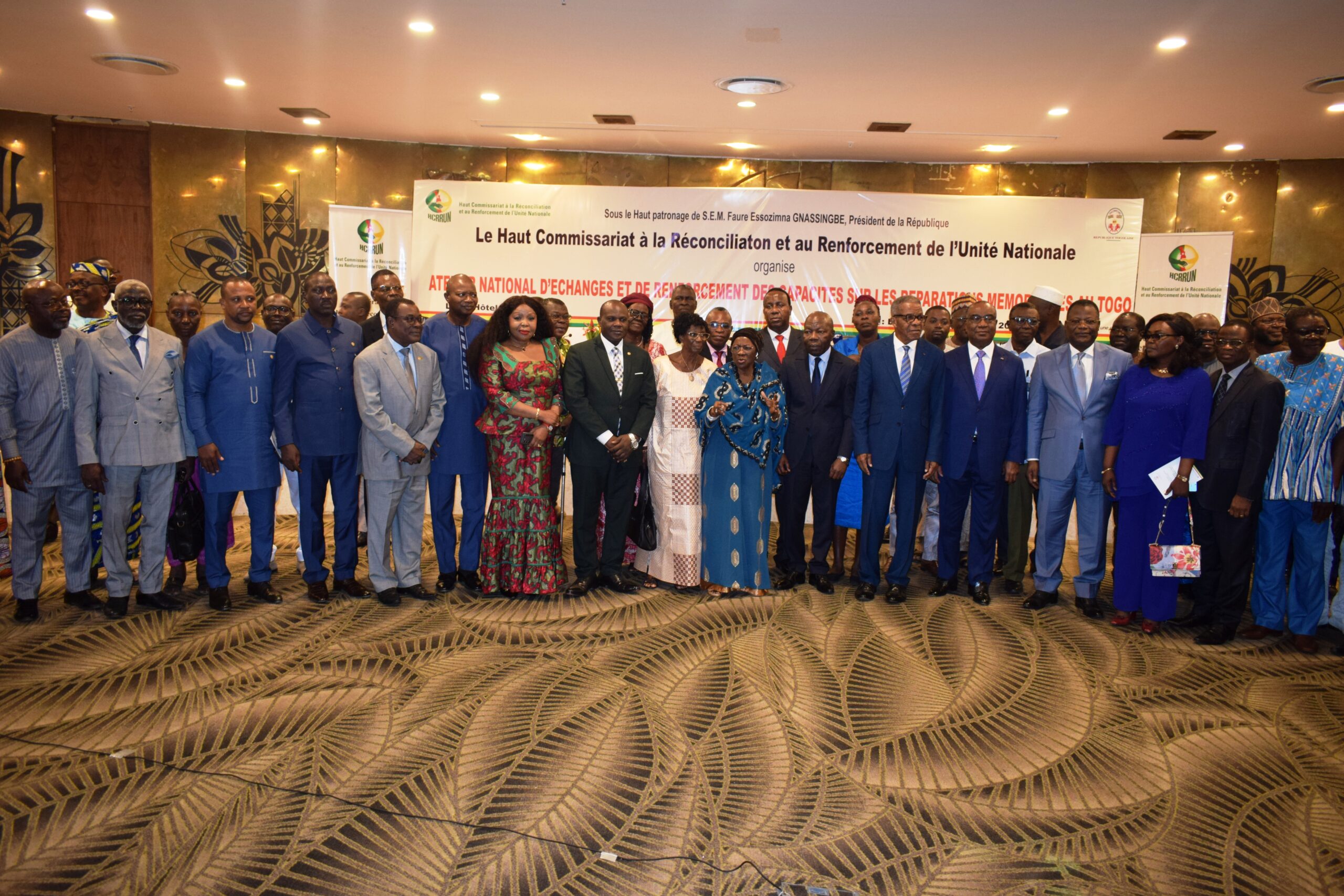
A national workshop on experience-sharing and capacity-building on memorial reparations was held from 10 to 12 December 2024 at the Hôtel 2 Février in Lomé. The opening ceremony was chaired by the Minister of Justice and Legislation, Mr Mipamb Nahm TCHOUGLI, representing the President of the Republic, in the presence of the President of the High Commission for Reconciliation and Strengthening of National Unity (HCRRUN), Mrs Awa NANA-DABOYA, along with government officials, institutional representatives and other distinguished guests.
Organized by HCRRUN, the workshop aimed to promote a shared national understanding of memorial reparations among citizens, public authorities and key stakeholders, with a view to securing broad-based support and participation in the implementation of this important component of the Reparations Programme recommended by the Truth, Justice and Reconciliation Commission (CVJR).
Over the course of three days, participants took part in discussions structured around three thematic panels: the role of memory in post-crisis societies; legal frameworks and memorial reparations in transitional justice processes: challenges and opportunities; and memorial reparations in Togo: issues, perspectives and challenges.
The workshop featured ten expert presentations addressing key themes, including the relationship between history and memory; memorialization mechanisms in transitional justice and the preservation of evidence of human rights violations; the conceptual and contextual foundations of memorial reparations; an overview of memorial disputes and contested narratives in the aftermath of Togo’s independence; and the contribution of memorial reparations to restorative justice, reconciliation and national cohesion in Togo.
In his opening address, Mr Mipamb Nahm TCHOUGLI, Minister of Justice and Legislation, welcomed the organization of this important national workshop, describing it as a reflection of the Government’s continued commitment to reconciliation and the promotion of human rights. He recalled that, by adopting the recommendations of the Truth, Justice and Reconciliation Commission and establishing the Reparations Programme, followed by the creation of HCRRUN to oversee its implementation, the State had firmly committed itself to the path of transitional justice.
He further emphasized that memorial reparations form part of a comprehensive public policy aimed at preserving collective memory, acknowledging past violations and strengthening national unity.
For her part, the President of HCRRUN, Mrs Awa NANA-DABOYA, explained that the workshop’s primary objective was to build a shared national understanding of the memorial reparations recommended by the CVJR. She stressed that the initiative sought to encourage dialogue among all stakeholders, foster public ownership of the process and secure the support of both decision-makers and the wider population.
She concluded by expressing the hope that the workshop would enable participants to develop credible and inclusive approaches capable of bringing Togolese people together around a shared memory that promotes reconciliation, mutual understanding and hope for the future.